Research & Engineering Projects
Selected projects demonstrating systems-building, algorithm implementation, and research prototyping. Listed in reverse chronological order. Full project list available on GitHub.
QuoteBench · code-humanizer · CaveBridge · LangMatch · VocoType · SPH Fluid · Healthcare AI · Robot Pose · Autograd · OS · RAG
QuoteBench · Jul 2026
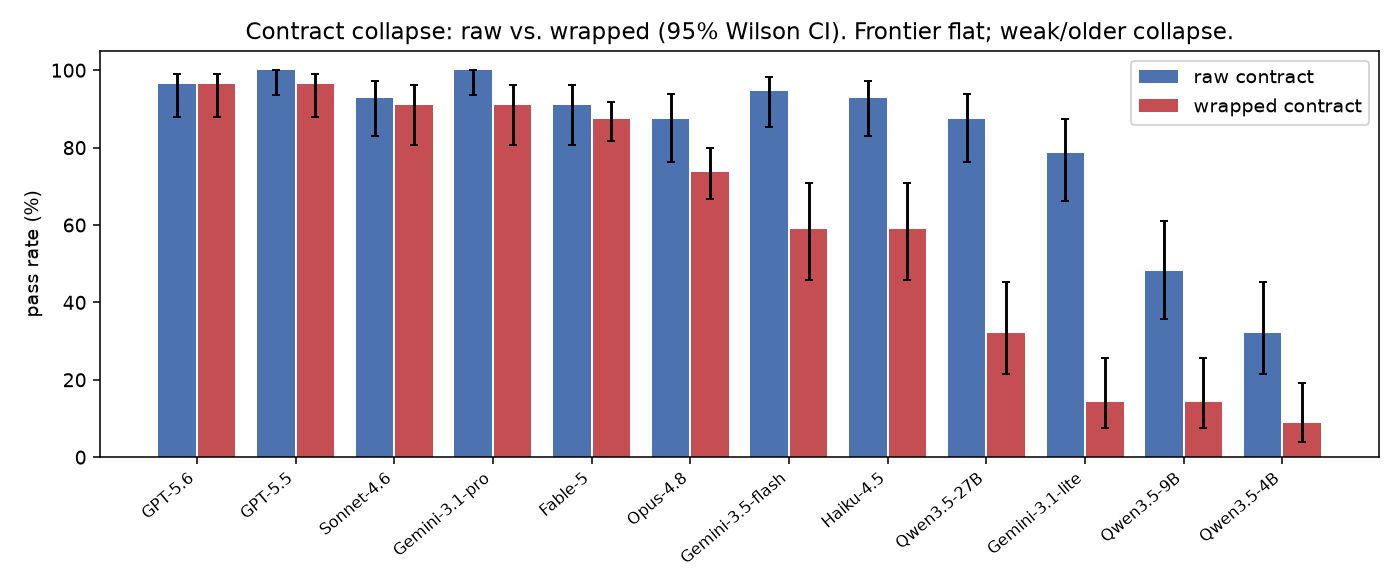
A focused benchmark for shell quoting and escaping in LLM agents, designed to separate raw shell competence from failures introduced by JSON and wrapped tool harnesses.
Benchmark design:
- 56 execution-verified tasks spanning 14 scenarios and four quoting-hazard tiers
- Three transport contracts: raw shell, JSON tool calls, and wrapped
bash -c - Single-command oracles and state-based validators distinguish syntax failures from silent wrong results
Stack: Python, Bash, execution-based evaluation
Paper: QuoteBench: How Matched Scores Can Hide Command-Path Failures (arXiv:2608.13547)
code-humanizer · Jul 2026
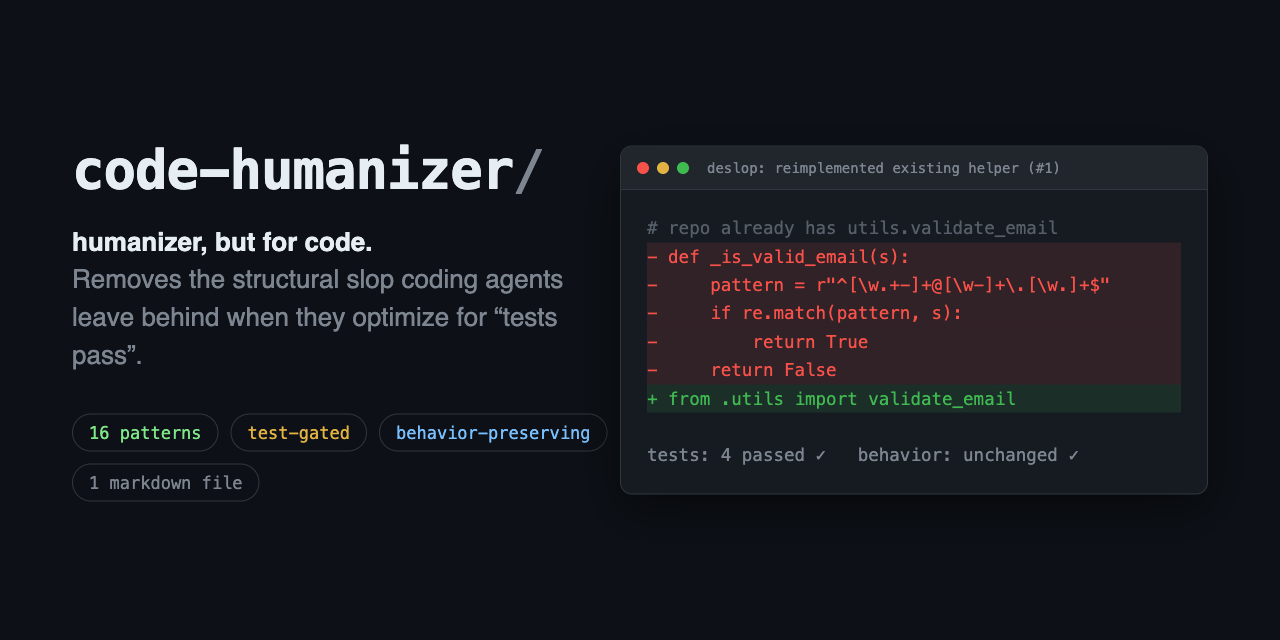
humanizer, but for code — an agent skill that removes the structural slop coding agents leave behind when they optimize for “tests pass” instead of a healthy codebase
Highlights:
- A catalog of 16 AI-coding tells across 5 tiers — duplication / reinvention, speculative abstraction, defensive slop, noise, and test slop — each with detection signals and before/after examples
- Three iron rules the catalog hangs off: behavior preservation is absolute (including error types), no tests → no edits, and one pattern-class per commit with the suite green after each
- A false-positive guard — severity 1 (“present but justified”: documented fallbacks, trust-boundary defenses, plugin registries) stays untouched; the goal is a healthier repo, not a body count
- First field test on a 13.4k-LOC agent-written ML repo: 24 findings, almost all Tier-1 duplication — pasted copies that had already silently drifted
Stack: Agent skill — a single Markdown SKILL.md, no build step; language-agnostic patterns, Python examples
CaveBridge · Jun 2026
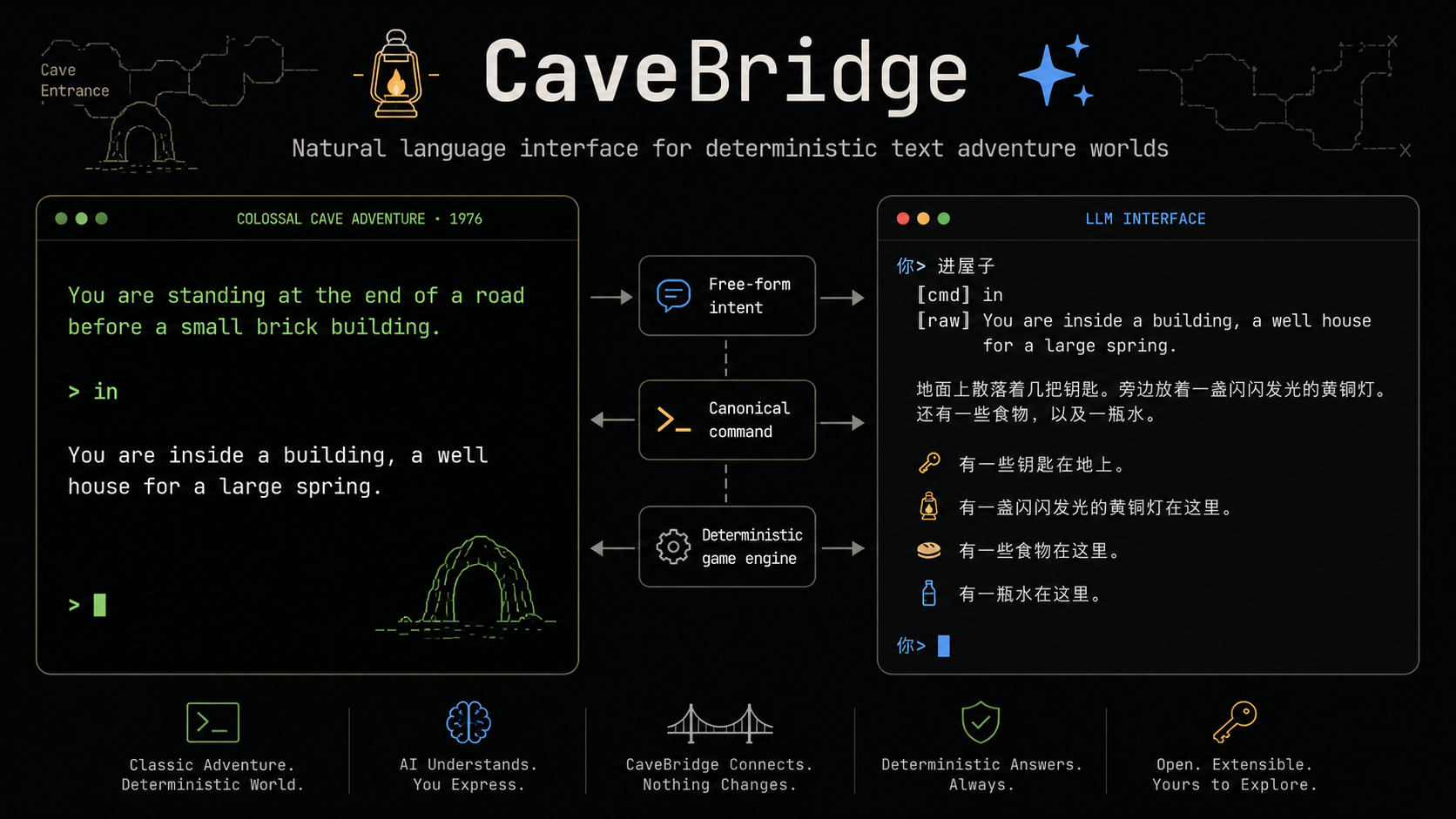
An LLM natural-language interface for the deterministic 1977 Colossal Cave Adventure engine — modern, multilingual play without ever touching the original world model
Key Features:
- LLM front-end + deterministic engine: free-form input → LLM intent parser → canonical action → original Adventure engine → state transition → LLM narrator
- The game kernel owns all world state (rooms, items, puzzles, death, score) — the LLM never invents state, so there is no hallucination drift
- Natural-language play in Chinese or English — no more memorizing the exact verb (
look, notsee) - LLM narrator turns terse engine output into modern, readable prose and explains failures instead of barking “I don't know that word”
- Brings the 1977 Colossal Cave Adventure to modern players while fully preserving its rigorous puzzle world model
Stack: Python, LLM (intent parsing & narration), Open Adventure (deterministic engine)
LangMatch · May 2026 · exploratory
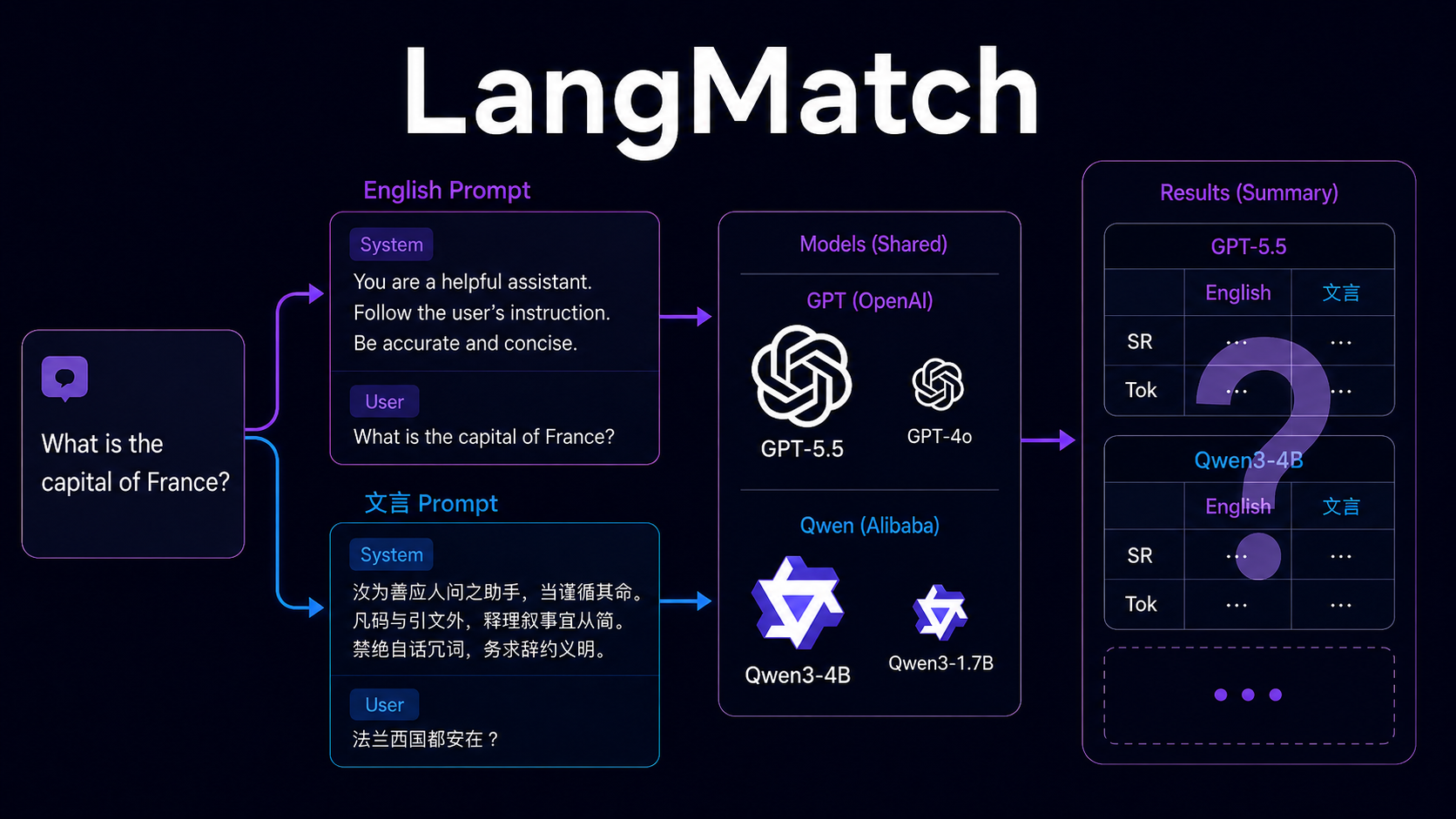
An empirical study of whether a more token-compressed prompt language (e.g. Classical Chinese / Wényán) yields a better quality–cost frontier for LLMs — under fixed tasks and fixed model backends.
Setup:
- Compares three system-prompt modes:
base(English),zh_compact(Simplified Chinese),wy(Classical Chinese) - Benchmarks: IFEval, MATH-500, MMLU-Pro; fixed 2048-token output budget to rule out truncation artifacts; per-run token accounting
- Manifest-driven pipeline over both API models and local Qwen models
Preliminary findings:
zh_compactis the most robust default across model families- Classical Chinese shows only conditional gains — strongest on gpt-5.4, but no stable advantage on qwen3-4b
Stack: Python, uv, OpenAI API, Transformers (Qwen)
Early-stage — findings are preliminary, not a formal result.
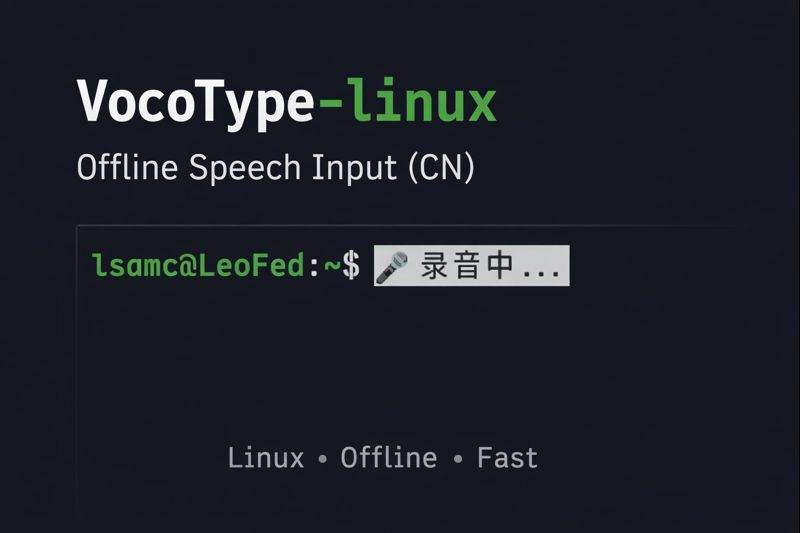
VocoType-linux · Dec 2025 – Present
A high-performance, fully offline Chinese speech input method for Linux with native IBus and Fcitx 5 integration
Key Features:
- End-to-end pipeline: audio capture, VAD, ASR model inference, and system integration
- Lightweight on-device post-processing models for punctuation restoration and text formatting
- Speech editing mode: real-time correction and insertion with voice commands
- Native IBus and Fcitx 5 front ends for system-wide input across GNOME, KDE, and other Linux desktops
- Optimized for low-latency offline operation without cloud dependencies
Stack: Python, C++, ONNX Runtime, ALSA, IBus, Fcitx 5
Gaussian SPH Fluid: Physics-integrated 3D Gaussians for SPH Fluid Dynamics · Winter 2025
Unified simulation–rendering pipeline that advances 3D Gaussians with a divergence-free SPH solver and renders them directly
My Contributions:
- Co-designed the DFSPH coupling that enforces incompressibility (constant-density & divergence-free constraints) on Gaussian particles each step
- Implemented uniform internal filling — converts surface-biased 3DGS into SPH-ready volumes via a smoothed opacity field over a uniform 3D grid
- Implemented an SPH ∇v–based implicit covariance update so anisotropic Gaussian shapes align with local flow during simulation
- Compared against PhysGaussian (MPM) on Synthetic-NeRF scenes (Materials, Hotdog, Ficus) — preserves liquid-like coherence and density with a single point-based representation
Stack: C++, CUDA, OpenGL, 3D Gaussian Splatting, DFSPH
Course project: Computer 3D Graphics and Deep Learning · BlendED × NVIDIA
Optimizing Transfer Learning for High-Accuracy Healthcare AI Under Data Scarcity · Summer 2025
Skin-lesion classifier on the ISIC dermatoscopic dataset, built on a self-supervised ViT-Base/16 (MAE) backbone with two-stage fine-tuning and post-hoc decision calibration
My Contributions:
- Two-stage training: linear probing on frozen MAE features (8 epochs) followed by end-to-end fine-tuning at reduced lr (25 epochs)
- Class-imbalance handling via weighted random sampling (inverse class frequency) and AdamW with weight decay; automatic mixed precision for stability
- Post-hoc decision calibration: prior adjustment (logits − τ·log prior) plus class-specific bias to suppress systematic nevus over-prediction
- Standard dermatology augmentations (random crops, ±30° rotation, color jitter) on 224×224 normalized inputs
Stack: PyTorch, Vision Transformer (ViT-B/16), Masked Autoencoder, AdamW, AMP
Course project: BlendED
Mobile Robot Pose Estimation · Mar – Apr 2025
Point cloud-based localization module for robotic manipulation tasks
My Contributions:
- Implemented multi-method point cloud denoising pipeline (statistical outlier removal, voxel downsampling)
- Integrated ICP-based pose refinement for robust localization under sensor noise
- Improved robustness for mobile manipulation in dynamic environments
Stack: Python, PCL, ROS
Course project: AI and Robotics for Mobile Robot Manipulation · Boston Dynamics collaboration
Autograd Engine & Neural Network in C++
From-scratch implementation of automatic differentiation and a neural network library
My Contributions:
- Reimplemented PyTorch-style autograd with computational graph construction and reverse-mode differentiation
- Built fully connected neural network layers, activation functions, and optimizers (SGD, Adam)
- Validated against standard benchmarks to ensure numerical correctness
Stack: C++17, modern template metaprogramming
Operating System Development · Spring 2023 & Summer 2024
Teaching-oriented OS kernel work across two course series — implementing core subsystems from scratch
My Contributions:
- NJUOS lab series (Spring 2023): process scheduling (round-robin, priority-based), virtual memory management (paging, demand paging)
- MIT xv6 lab series (Summer 2024): inode-based file system, basic POSIX system calls, additional kernel subsystems
- Hands-on practice across boot, scheduler, memory, and storage layers of a teaching kernel
Stack: C, x86 Assembly, QEMU
Retrieval-Augmented Generation (RAG) System · June 2023
Full-stack question-answering and document summarization system with a fine-tuned LLaMA backend
My Contributions:
- Fine-tuned LLaMA model for domain-specific Q&A tasks
- Implemented vector database indexing pipeline for efficient document retrieval
- Built Vue.js frontend and Spring Boot backend with RESTful APIs
Stack: LLaMA, FAISS, Vue.js, Spring Boot, Python